A concept for an app that puts a real, trusted bilingual person on your side in China — someone who waits, who listens, and actually helps.
这
个
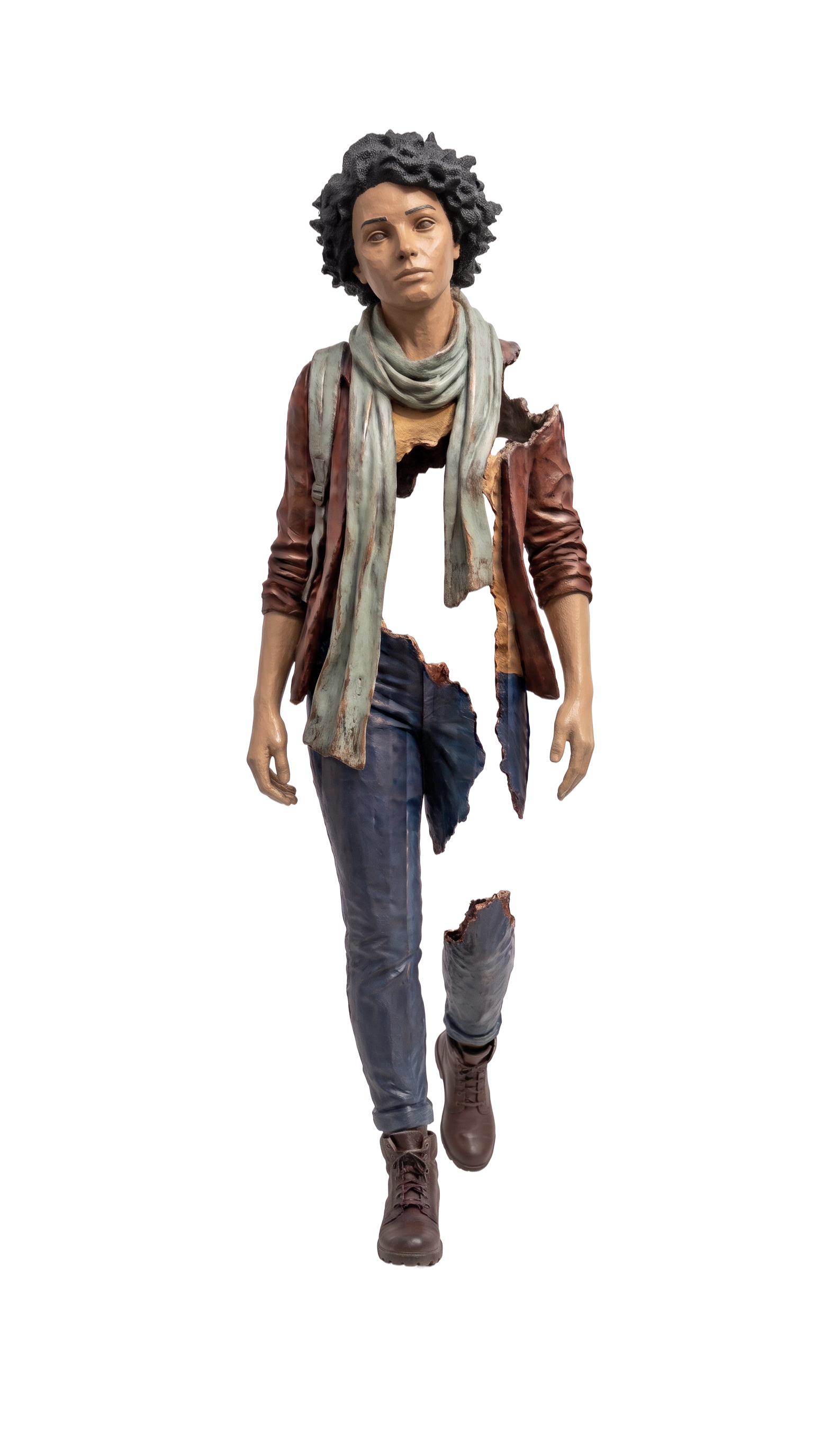
Inspired by Bruno Catalano’s Les Voyageurs
Product design, brand & the working build Self-initiated concept · iOS 2026 Research · UX · UI · Prototype
It was never really about the language.
When a foreigner struggles here, the advice is always the same: learn the language. It's fair advice. I took it, not fluently, but enough to get by.
It didn't save me. And the more people I spoke to, the clearer it got that it doesn't save them either.
Every day, people ask a room full of strangers how to live here: which visa, how tax works, whether a school is real, whether a recruiter is a scam. Not because the answers don't exist, but because there's no reliable place to find them, and no one to turn to.
Underneath it sits something heavier, and it isn't a vocabulary problem. Who do you hand your passport to? Who do you trust with your health, or your visa, or a contract you can't read? You can't translate your way to an answer like that.
An insight into some moments that stuck in my mind.
A moment · the hospital
I hurt my hand a while back and wanted to see a specialist to be certain what the cause was, as there's a history in my family of certain diseases. I worked out which doctor to see, booked online, had the scan done.
The results ran late, so I went to move my appointment. The first receptionist read my translator app and was kind about it. When I came back, she'd gone. The second one wouldn't wait for me to type into a translator to explain. She scanned me in and so I saw the doctor with nothing to show him. He looked at my cast, decided he knew what it was, and told me I was in the wrong place. I wasn't. I'd checked. In that moment I felt very much alone and frustrated.
A moment · not mine
Someone I spoke to arrived right as the pandemic hit and went straight into lockdown, no orientation, no welcome. Here's how he described those first months:
“They basically just threw us into the dorms and said, ‘You live here. Now figure the rest out on your own.’ Our Chinese wasn't good enough to figure much out on our own and whenever we asked a teacher even a basic question, they’d just tell us, ‘Here’s the website, go look it up and figure it out yourself.’ We were thrown into the deep end, left to navigate this abyss and find our own way out.”
He had studied Chinese and knew the language somewhat, but it wasn't enough to get answers to even the simplest of questions.
No one would wait long enough to listen, or to actually see the problems foreigners face here.
Point at it, and a real person helps.
zhè·ge
这个·pronoun
1
this one; this. Used to point at something rather than name it.
2
informal, among foreigners in China
the first word you learn, and the one you fall back on when you have none of the others.
“just point and say zhège.”
OriginMandarin 这 zhè ‘this’ + 个 ge, the general measure word for almost anything.
zhège means “this one”, the word you say when you point at something you can't name. That's the whole product: point at what you're stuck on, and a verified bilingual person takes it from there, in the language of your choosing, by call or by text.
Not a translator. Not a chatbot. A person who waits, who listens, and who stays until the thing is actually done.
And I know the first question: why not just ask AI? I asked it myself when the idea came. But it comes down to trust. Laws here can change overnight, and an answer that was right last month can be wrong today. You can't prepare for every situation. The proof is earlier in this story: AI already exists, and people still ask people. zhège just gives you a tunnel straight to them, without the hunt through groups and threads.
The meme that started it.
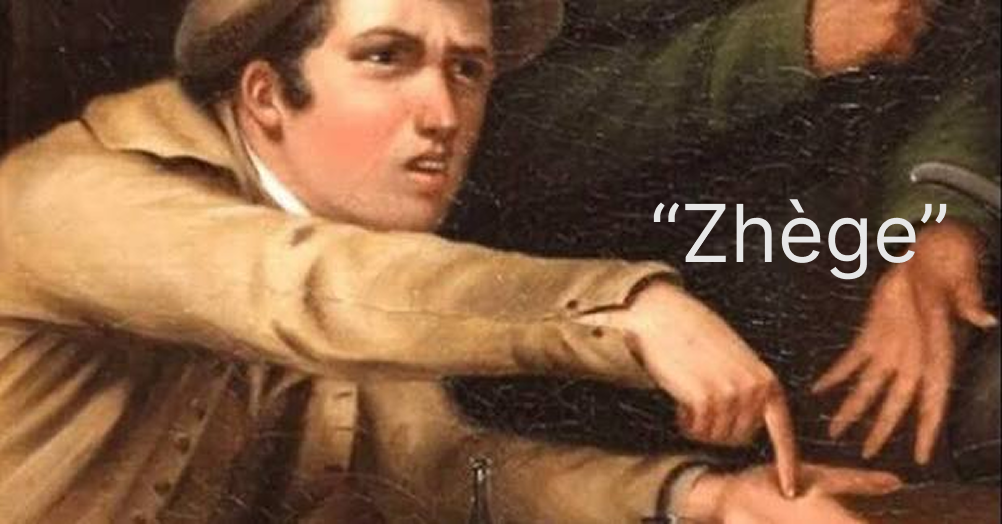
The word is so universal it turned into a meme: a man in an old painting, jabbing his finger at the table, saying “zhe ge.” Anyone who has lived here knows it on sight.
The zhège meme.
The idea came in the middle of one of those moments. I was stuck again, looking for help I couldn't find. In defeat I had sat down and tried to cheer myself up with some funny videos when I came across this meme. It used to be funny. Right then it wasn't, because I was living the exact thing it jokes about. Even my lifeline word couldn't help me. Pointing only works when someone is willing to take the time to read the translation and translate back to you.
So the thought was simple. If I don't have that person, someone who could get me through these situations, then let me create something so that everyone can have that person. That's exactly where zhège came from, in that moment.
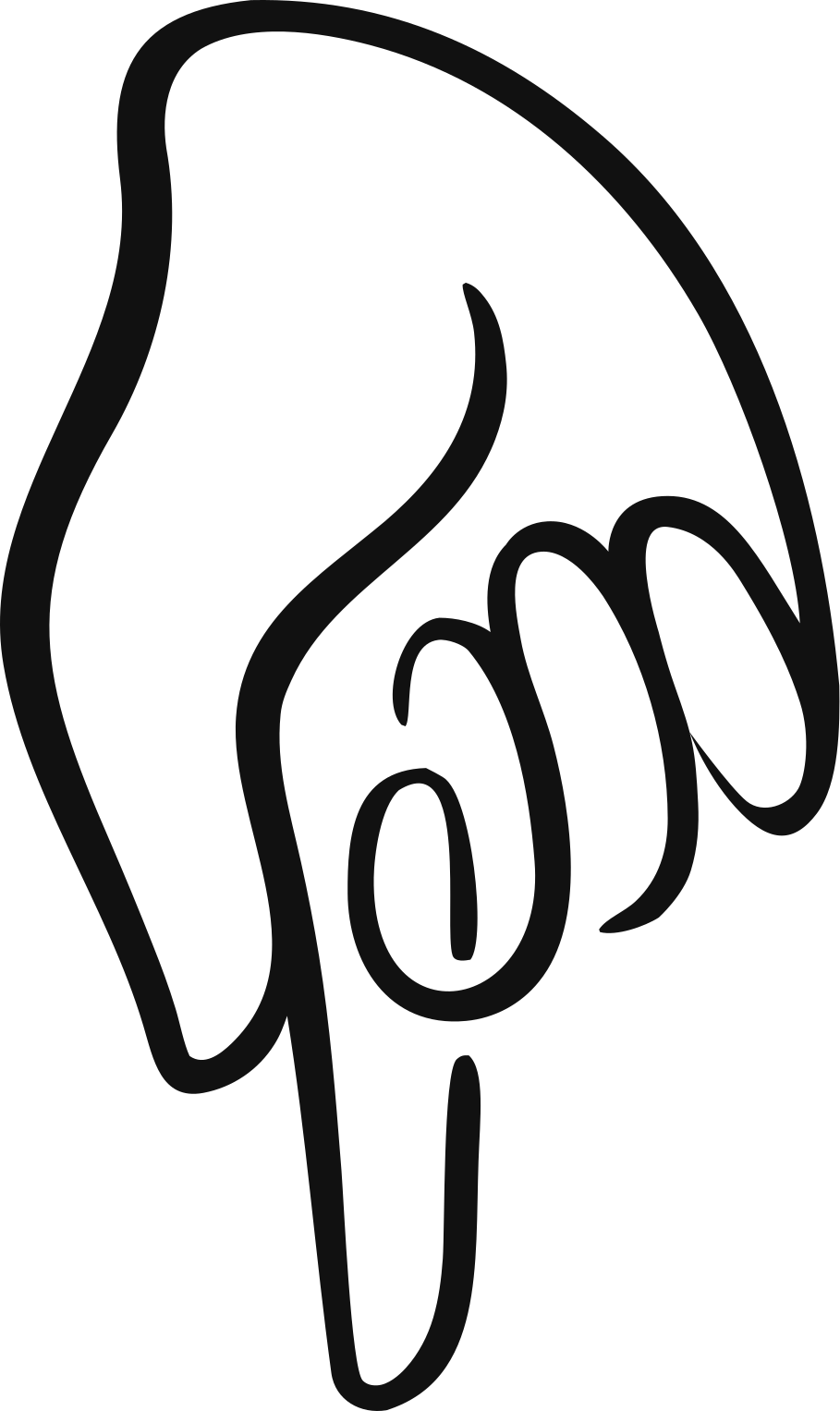
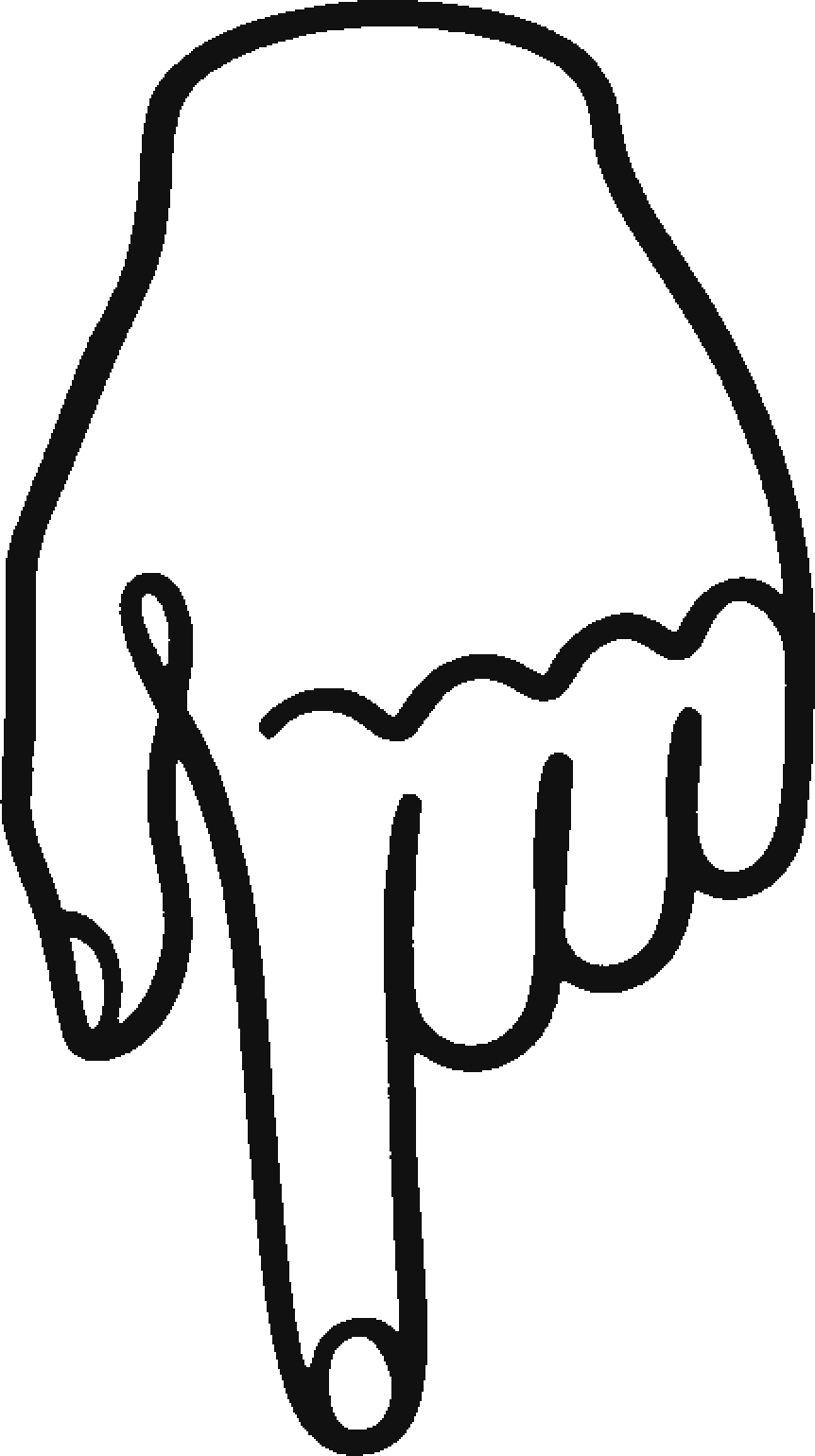
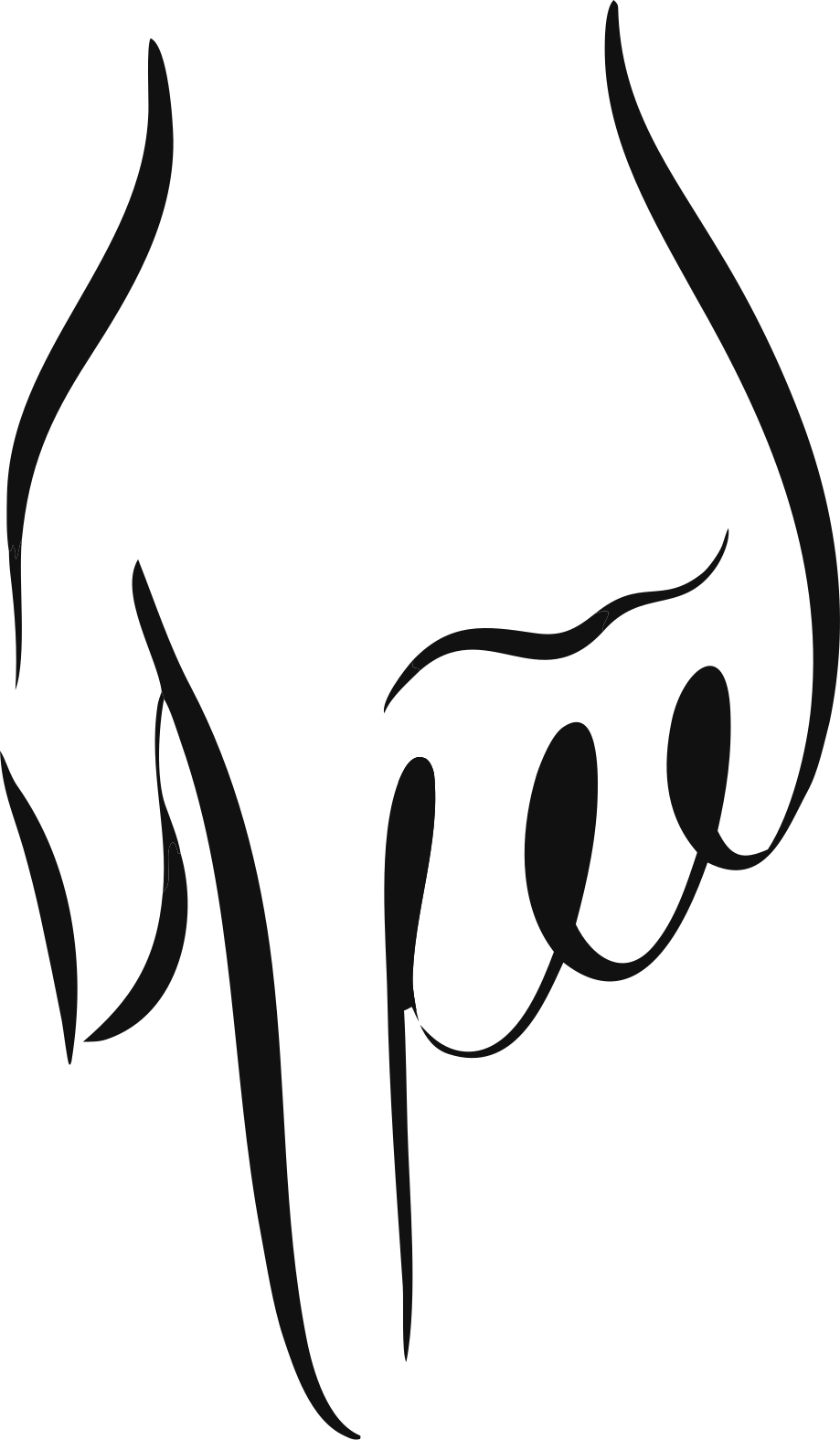
The logo came from the meme too.
The gesture.
The gesture, written.
v1
v2
v3
Three versions to get the strokes right.
A friendly helper is now a tap away.
Pick a topic and we find a helper who speaks your selected language and is happy to guide you through any situation. They'll make the Chinese phone calls for you, guide you to a trusted provider of a specific service you need, or provide you with any information you seek. And if it's not on the list, there's always an "other".
User portal
The text lane · tap what pulses, watch the chat happenThe call lane · connected, then rated
A solution that gives back.
The helpers are the other half of the product. They're bilingual locals, many of them young graduates in a job market with not enough jobs to go around. What they know, how things actually work here and how to say it in two languages, took years to learn, and there has never been an easy way to get paid for it.
So it helps in both directions at once: the foreigner who can't get through the door, and the local who can open it. Helpers choose the requests they take, work when they want, and build a reputation one help at a time. The human part is the part AI can't replace, so that's exactly the part we pay for.
Helper portal
Lin's side · the beagle request arrives, accepted, answered
A recommendation only helps if you can trust it.
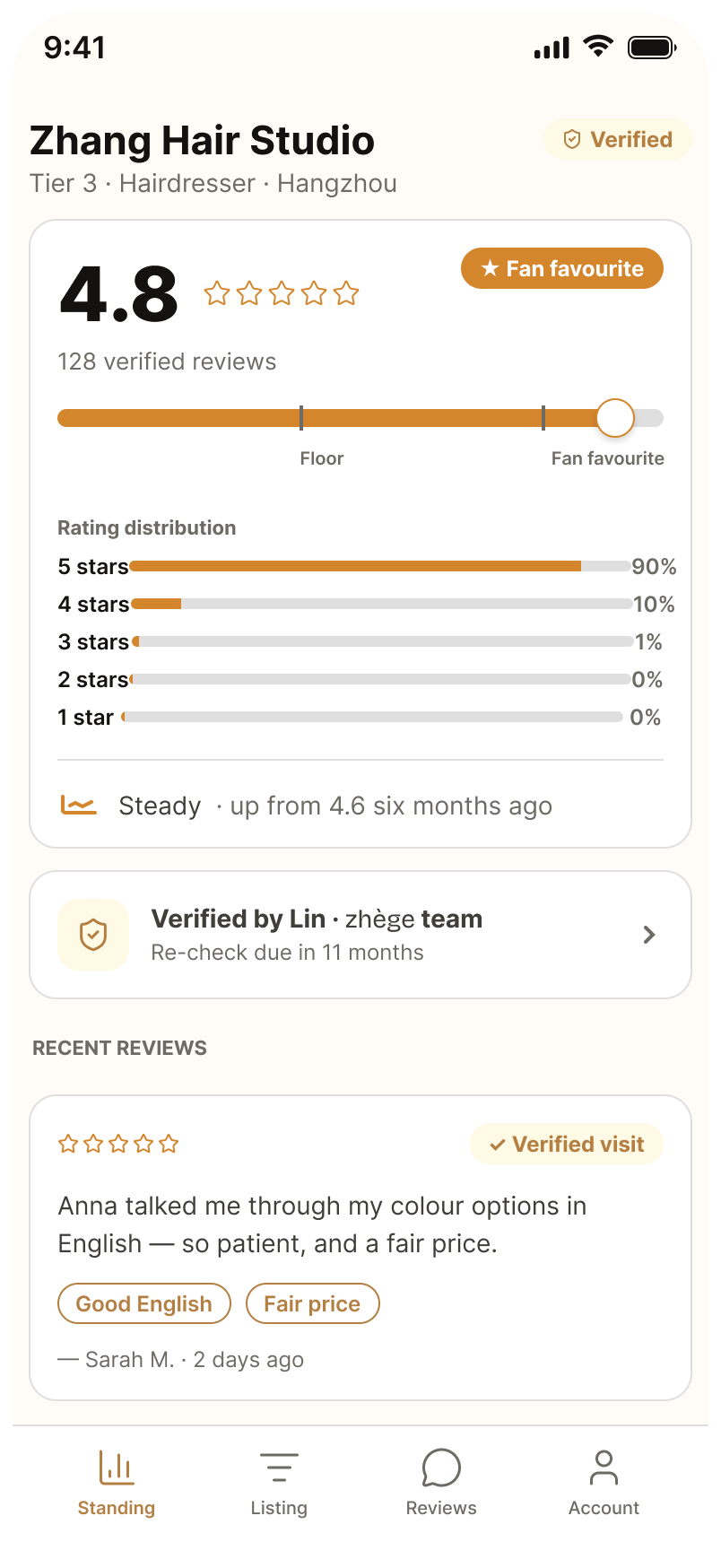
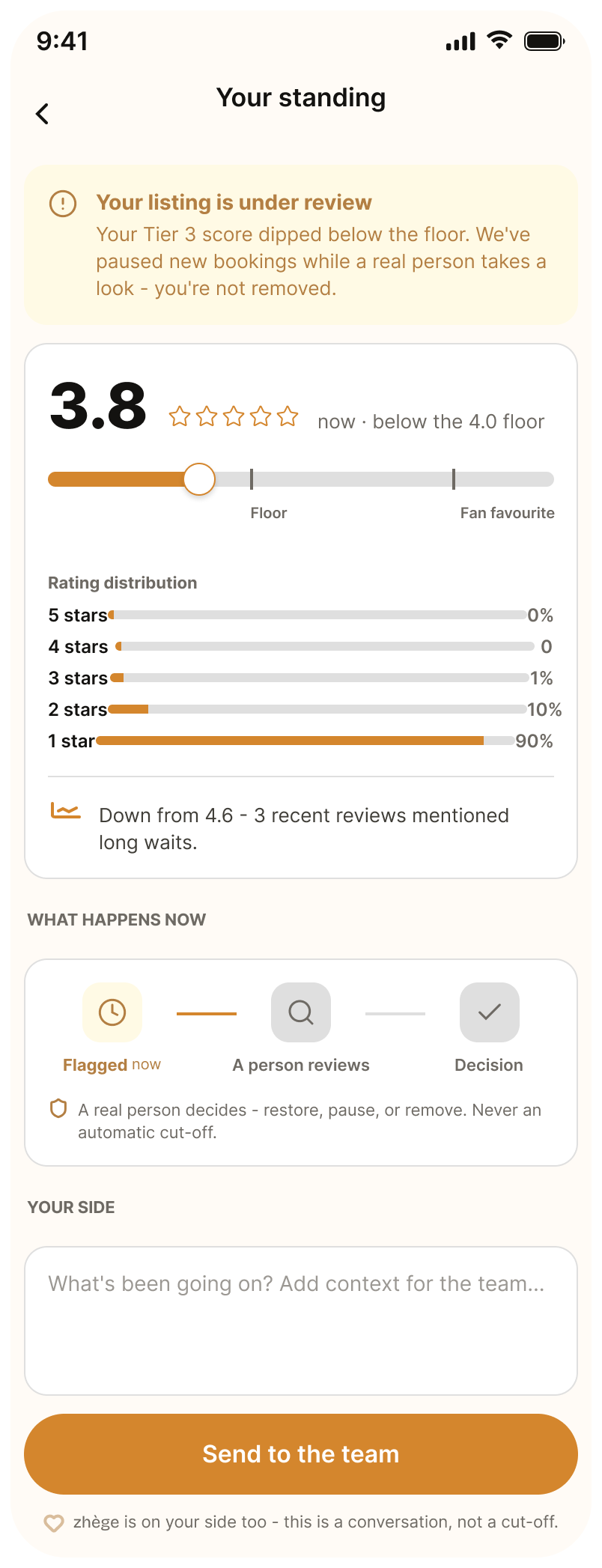
Helpers work for the app. The providers they point you to don't, so verification became the heart of the product. A bad notary can cost you a visa; a bad haircut can't, so strictness scales with the risk. And the stakes follow the job, not the person: an everyday provider taking on anything that touches your papers, your health, or serious money is held to the stricter bar for that job. Providers prove they're real several ways, and if a score slips, a real person looks, never an automatic cut-off.
Provider portal
The real verification flow, live. Click Continue in the screen to walk it.
Standing · verified reviews against the floorBelow the floor · a person reviews, never an automatic cut-off
The design system.
The full system behind everything above: one orange, dark and light as equal peers, Bricolage for the loud moments and Inter for everything else. Every token and component is drawn from the shipped screens.
Every screen, as shipped.
The approved zhège screens — each in light and dark.
The system, not just the screens.
zhège started as a feeling and every moment in this story is what brought the app to life. I designed for that feeling first, then built the system that earns the trust: stakes that follow the job, verification on many signals, a real person deciding.
It's about finding humanity again in a place where you sometimes feel like you're losing it.
And everything you just walked through is really built. The journeys, the chat, the verification flow: coded, clickable, working. I designed the screens in Figma and directed AI to ship them, because a concept about trust shouldn't ask you to take its word.